
Alexandrite Buying Guide for Collectors
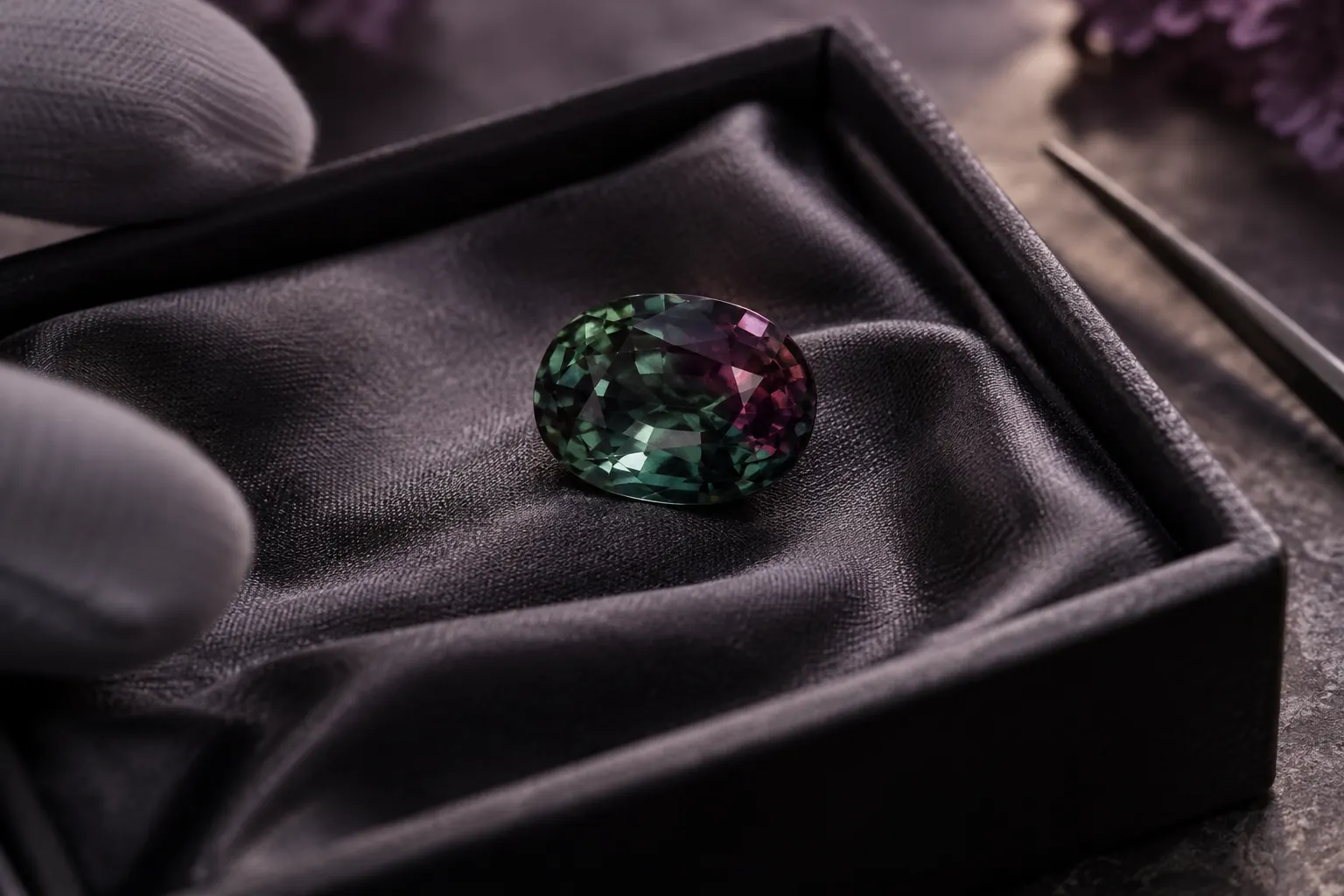
Alexandrite invites attention through a change in appearance under different lighting. A collector’s brief should explore the effect, the individual stone and the evidence supporting its description.
Understanding the color-change effect
GIA identifies alexandrite as a rare variety of chrysoberyl. Its color may appear green under daylight or fluorescent light and shift toward brownish or purplish red under incandescent light. GIA attributes this behavior to the way the mineral absorbs light. The effect responds to illumination; it should be assessed with attention to the viewing conditions. GIA’s description of alexandrite provides the gemological background.
This makes a single photograph an incomplete basis for a selection. Before drawing conclusions from a seller’s images, ask how the stone was lit, whether the images were adjusted and how the appearance can be evaluated under the conditions relevant to the proposed review.
Begin with identity
Ask what supports the description of the material as natural alexandrite. A trade description should lead to a documentation question, not end it. Read the report for the specific stone and identify the statements it makes, the material it describes and any limits relevant to your decision.
Keep the distinction between an observed color change and an established identity clear. An appealing visual effect is a reason to examine a stone further; it is not a substitute for the information required to identify it.
Evaluate the whole stone
A useful brief can record your priorities for appearance, the character of the color change, condition, proportions and intended use. Ask which of those questions can be answered from the supplied material and which require a closer examination. Do not let one striking feature make every other question disappear.
Questions before a selection
- What documentation supports the material’s stated identity?
- What lighting conditions were used to show the color change?
- Can the viewing conditions and any image adjustments be explained?
- What condition, treatment or origin information is available, and what remains uncertain?
- How does this particular stone relate to the reason you want to own it?
Keep the answers with the record of the stone. If further specialist assessment is needed, identify that requirement before treating a description as settled. No general guide can authenticate a reader’s individual stone.
A longer view of ownership
A collector considering a stone within a wider wealth picture should separate three different questions: why the stone is personally appealing, what information supports the selection and what practical limitations accompany ownership. A satisfying answer to the first does not automatically answer the other two.
For generational ownership, consider the record that will accompany the collection. Keep the relevant documentation, descriptions and purchase records together, and distinguish assessed information from an assertion that remains unconfirmed. A future owner should be able to understand both the material and the limits of the available evidence.
For portfolio diversification, examine suitability rather than assume a benefit from the category name. A stone is an individual holding; an asking price is not an offer to buy it back. Consider the proposed holding period, possible ownership costs, and what would happen if you needed to sell sooner than expected.
Stone values can fluctuate. Resale is not guaranteed. This guide presents general information and questions for a considered selection; it is not an authentication, valuation or promise of investment performance.
For a focused conversation about a particular stone or your ownership objectives, explore Colored Stone Consulting, compare a different color-led decision in our Tourmaline Buying Guide, or make a private enquiry. Define the scope before sharing additional material or making a commitment.
Sources and further reading
These sources support the general gemological information in this article. Their inclusion does not imply an affiliation with Gem Wealth Capital or an assessment of any stone offered to a reader.